
Rodent Removal in Midtown Sacramento
Midtown packs old buildings tightly together behind service alleys, under some of the heaviest street canopy in the city. That combination brings both the climbing rat and the ground rat, often to the same address.
- Victorian and Craftsman stock
- Alley and canopy pressure
- Free inspection, itemized quote
Old buildings, small lots, shared walls
The Midtown grid is mostly pre-war and it is dense. Victorians, Craftsman houses and early apartment buildings sit on narrow lots, many of them subdivided into flats or converted to offices and small businesses over the decades, and a good number have had a century of alterations: a rear addition, a closed-in porch, a new service entry cut through an old wall.
Every one of those alterations is a potential opening, and they are the ones a routine inspection misses. A conduit run added in the 1970s through a foundation wall. A gap where an addition meets the original structure. A disused gas or plumbing penetration left unplugged. Houses of this era typically sit on a raised foundation over a ventilated crawl space, so the underfloor is in play as well as the attic.
Shared walls and close neighbors matter too. On a lot line where two buildings are a few feet apart, an animal moving between them treats the pair as one structure, which is why a sealing job that stops at your own property line sometimes does not hold.
The alleys behind the blocks
Midtown keeps its service access at the back, and the alleys are a standing food and cover supply. Bins and dumpsters, recycling, restaurant waste on the commercial blocks, and the gaps under fences and gates all work in a rodent's favor, and they work for both species at once.
That is the part that distinguishes Midtown from a purely residential neighborhood. Roof rats come off the canopy and into the attic, as they do across the older city, and Norway rats work the ground: UC IPM places them at ground level and below, usually in burrows, with a nightly range of 100 to 500 feet. An alley running the length of a block sits comfortably inside that range for every building on it.
Practically, an inspection here looks at the back of the building harder than the front, and the advice usually includes bin management and the gap under a gate, which nobody can seal for you.
Heavy canopy over narrow streets
The street trees in Midtown are tall and close to the buildings, which on a narrow lot means limbs within reach of a roof more often than not. The city urban forest plan counts roughly a million trees and about 19 percent canopy cover across Sacramento, with a target of 35 percent by 2045, and the older central grid carries the densest share of it.
For a roof rat, that is a network rather than a single route. UC IPM describes them traveling up to 300 feet or more to reach food and living in attics, wall voids and ceiling voids, so a tree on the sidewalk, a wire to a fascia and a neighbor's fruit tree two lots along are all one system. Sealing the building is the only part of that system under your control.
What a visit in Midtown looks like
The inspection runs the perimeter first, including the alley side, which is where most of the findings are. Foundation vents and the crawl space door, any burrow openings against the building or the fence line, the bin area, the gaps under gates, then the additions and the service penetrations, then the roofline and the attic.
Where both species are present the trapping splits: snap traps along the attic runs for the roof rats and at grade and in the crawl space for the ground rats, spaced 10 to 20 feet apart as UC IPM advises. Sealing is staged the usual way, with the quiet openings closed first in half-inch hardware cloth and sheet metal and the active runs closed once the checks come up empty.
The services these blocks call for are roof rat removal, Norway rat removal and rodent exclusion, often all three, and commercial rodent control where the building is mixed-use. The about page explains who attends and what to check.

What is moving inside the walls
How noise in a wall cavity gets traced.
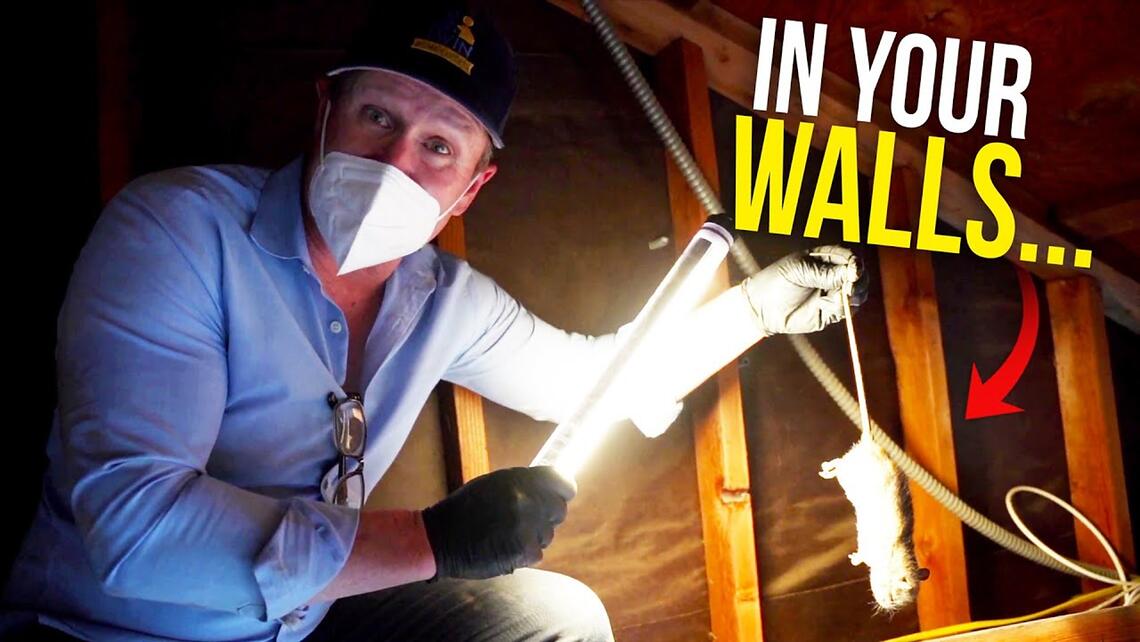
Video: Rodents in your walls? Here's what you do, from Twin Home Experts.
What a Midtown job has to account for
Three conditions that are particular to this part of the city.
Both species, in the same building
A climbing rat in the attic and a ground rat in the crawl space are two different trap plans, two different opening lists and, on a Midtown lot, frequently the same address. The inspection names each species from its own evidence rather than assuming one, because a plan built for the wrong one fails while looking busy.
UC IPM puts Norway rats at ground level and below, and roof rats in attics and wall voids.
A century of alterations to find
The openings that matter in an old Midtown building are often the ones somebody added: a conduit through a foundation wall, a closed-in porch meeting the original structure, a disused service penetration. They are invisible from the street and they are the reason a careful survey here takes longer than a newer house.
UC IPM has a young rat passing under a door with a half-inch gap.
The alley is part of the problem and part of the remedy
Bins, restaurant waste and the gap under a back gate keep pressure on the whole block, and no amount of steel on one building removes it. What sealing does is make your building the one that holds. The inspection says plainly which of the findings are yours to fix and which belong to the alley.
UC IPM gives a Norway rat a nightly range of 100 to 500 feet around the nest.
A typical Midtown call
The situation: A 1905 Victorian divided into three flats on a numbered street, with a service alley behind. One tenant reporting movement in the ceiling after midnight, another finding droppings in a ground-floor kitchen cupboard, and the owner unsure whether that was one problem or two.
What gets done: It is two. The attic carries rub marks and droppings along the rear perimeter joists, reached from a limb touching the back roof slope. The ground floor traces to the crawl space, where a burrow has been driven in under the rear foundation wall beside the bin area, and an old abandoned conduit penetration is open behind the kitchen cabinets. Traps go into the attic runs and at the burrow mouth, the conduit is packed and capped, and three foundation vents are rescreened.
How it turns out: Four visits over about three and a half weeks, because two species on one building takes longer than one. The back roof junction is closed after the attic goes quiet, the burrow is collapsed once the ground trapping stops producing, and the owner moves the bins off the foundation wall onto a hard standing. The quote carried five separate lines.
Midtown questions
What callers from the central grid ask.
My neighbor's building is the source. Is sealing mine worth it?
Yes, and on a Midtown lot it is the only lever you have. UC IPM gives a Norway rat a nightly range of 100 to 500 feet and has roof rats traveling up to 300 feet or more for food, so pressure from a neighboring building or an alley will keep arriving whatever happens next door. Closing your own envelope is what decides whether that pressure gets inside. The survey also documents the external source, which is the evidence for a conversation with a landlord or a property manager.
I have tenants. How disruptive is this?
Less than most people expect. The bulk of the work is outside and in the crawl space and attic, and interior trapping is usually confined to the rooms carrying the sign. What needs planning is access: an attic hatch inside a flat, a crawl space door behind a gate, and notice to tenants for the trap checks. Tell the dispatcher the building is tenanted and the visits get scheduled accordingly.
Is the alley the city's responsibility?
Bin management and the waste on your own property are yours. Where a rodent complaint involves a neighboring property or a wider nuisance, Sacramento County Environmental Management inspects rodent complaints and can issue abatement notices, which is the route for something outside your control. The Sacramento-Yolo Mosquito and Vector Control District is mosquito-focused and does not handle rat removal, which is a common mix-up.
Can somebody come out at the weekend?
Inspections run seven days a week between 7am and 7pm, and the phone itself is answered 24 hours a day, every day, so the booking can be made whenever suits you. The dispatcher takes the next open slot from the contractor covering Midtown. Whether anyone can attend outside those hours depends on the contractor dispatched.